
IT Staff Augmentation vs. Traditional Hiring

IT staff augmentation and traditional hiring represent two distinct approaches to building technical teams. Staff augmentation provides flexible, temporary access to specialised talent without long-term commitments, enabling quick adaptation to project demands and reducing overhead costs. Traditional hiring focuses on permanent employees, fostering organisational stability through comprehensive benefits and career advancement opportunities.
Staff augmentation provides quick deployment and scalability with pre-vetted professionals, whereas traditional hiring fosters lasting knowledge and a stronger company culture.
Key Takeaways
- Staff augmentation offers immediate access to specialised skills without long-term commitments, while traditional hiring requires extensive recruitment and onboarding processes.
- Traditional hiring builds stable teams and organisational knowledge, whereas staff augmentation provides flexibility to scale resources based on project demands.
- Staff augmentation typically has higher hourly rates but lower overall costs, eliminating benefits packages and reducing overhead expenses compared to traditional hiring.
- Staff augmentation accelerates time-to-hire through pre-vetted professionals, while traditional hiring involves lengthy recruitment, screening, and interviewing processes.
- Traditional models foster long-term employee loyalty and cultural integration, while staff augmentation enables quick adaptation to changing project requirements.
What is IT staff augmentation?
IT staff augmentation allows organisations to temporarily expand their teams by adding external IT professionals. This flexible approach offers immediate access to specialised skills, adapts to project demands, and avoids long-term commitments. It’s ideal for scaling technical capabilities, managing workloads, and integrating expertise in emerging technologies, ensuring agility and cost-effectiveness for businesses.
What is traditional hiring model?
The traditional hiring model recruits full-time, permanent employees who form the organisation’s core team. It offers stability, fosters long-term relationships, and includes benefits like health insurance and paid leave. Though requiring higher upfront investment, it ensures workforce loyalty, deep institutional knowledge, and consistent operational standards, making it ideal for organisations seeking stability and long-term growth.
Key Differences: IT Staff Augmentation vs. Traditional Hiring Models
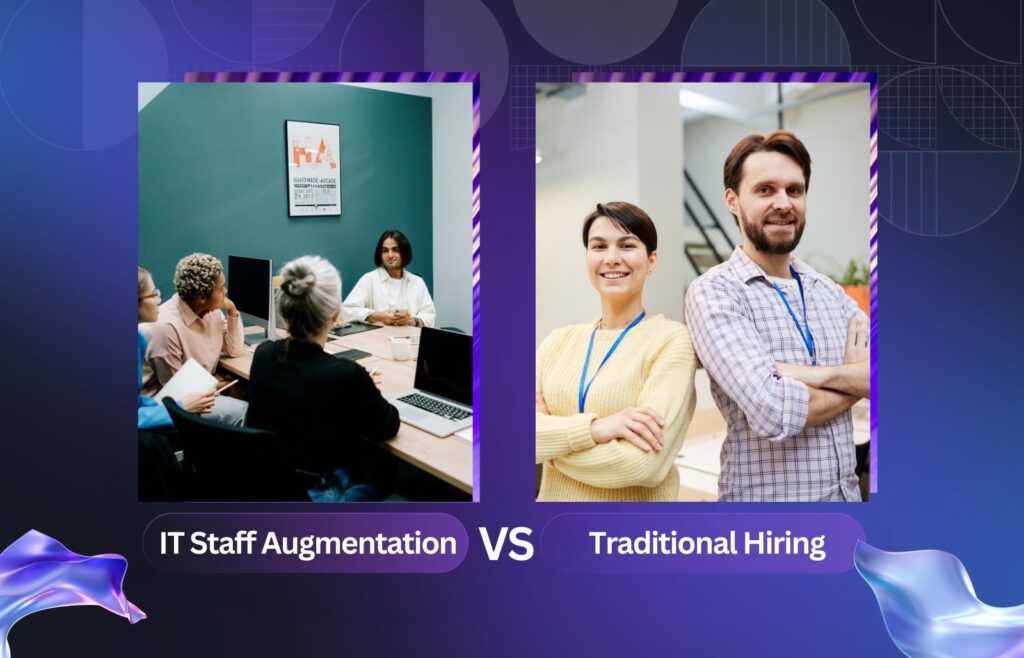
The fundamental differences between IT staff augmentation and traditional hiring models centre on three critical aspects: flexibility and scalability, cost implications, and control and management structures.
| Aspect | IT Staff Augmentation | Traditional Hiring |
|---|---|---|
| Flexibility and Scalability | Rapid workforce adjustments based on project demands. | Requires time-intensive recruitment and onboarding processes. |
| Immediate access to specialised skills. | Permanent staffing solutions that offer deeper organisational integration. | |
| Enables seamless team downsizing post-project completion. | Long-term commitments to maintain staffing levels regardless of demand fluctuations. | |
| Expands capacity swiftly during peak periods without permanent obligations. | Limited flexibility for rapid scaling or downsizing. | |
| Cost Implications | Lower upfront costs; no need for comprehensive benefit packages. | Higher initial investment for recruitment, onboarding, and training. |
| Flexible, project-specific payment model optimises budgets. | Long-term expenses include salaries, benefits, insurance, and professional development. | |
| Reduces financial risk by avoiding overhead costs during downtime. | Represents a strategic long-term investment in human capital. | |
| Higher hourly rates, but cost efficiency through scalable resource allocation. | Fixed costs regardless of changing demand levels. | |
| Control and Management | Direct oversight of external professionals with flexible management strategies. | Structured hierarchies and permanent reporting relationships provide stability. |
| Simplified integration into existing teams reduces management overhead. | Extensive onboarding and career development processes require consistent management investment. | |
| Focus on project-specific objectives allows adaptability to dynamic environments. | Broader career development goals strengthen organisational culture and cohesion. | |
| Agile management approach tailored to project needs. | Adherence to established organisational protocols may limit responsiveness to rapid changes. |
Flexibility and Scalability
IT staff augmentation offers unmatched flexibility, allowing organisations to quickly scale teams up or down based on project needs. It provides instant access to specialised skills, enabling resource allocation for urgent tasks without long-term commitments. This cost-effective approach adapts easily to changing business demands compared to traditional hiring.
Cost Implications
Staff augmentation reduces upfront costs by avoiding benefits and insurance, ideal for short-term projects. Traditional hiring involves higher expenses for recruitment, training, and salaries. While hourly rates may be higher for augmented staff, the ability to scale teams as needed often makes it a more budget-friendly choice.
Control and Management
Staff augmentation ensures direct oversight and quicker integration of external professionals, ideal for fast-moving projects. Traditional hiring offers long-term stability and structured management but lacks flexibility. Businesses must assess whether short-term agility or long-term cohesion better suits their objectives.
The three staffing model
Organisations today have three primary staffing models to choose from when building their IT workforce: insourcing, outsourcing, and staff augmentation.
Insourcing
Establishing a permanent in-house workforce through insourcing represents one of the fundamental approaches to IT staffing. Unlike staff augmentation, which offers temporary solutions, traditional hiring focuses on building a stable team of permanent employees who become deeply integrated into the company culture.
While this approach requires significant upfront investment, it creates a foundation for long-term organisational growth and knowledge retention.
Benefits:
- Cultural alignment: Employees fully integrate with company values and goals.
- Knowledge retention: In-house teams accumulate valuable institutional expertise.
- Control: Direct oversight ensures alignment with organisational objectives.
Challenges:
- High costs: Significant investment in recruitment, training, and benefits.
- Limited scalability: Adjusting workforce size can be time-consuming and resource-intensive.
Best for: Organisations with consistent, long-term staffing needs and a focus on building a stable, cohesive team.
Outsourcing
Many businesses turn to outsourcing as a strategic alternative to traditional hiring models, leveraging external service providers to manage specific IT functions while significantly reducing operational costs. Research indicates that companies can achieve cost savings of up to 85% by outsourcing various services, including IT and digital marketing, compared to traditional hiring models.
This approach enables organisations to delegate routine tasks to specialised providers, allowing internal teams to concentrate on core business objectives and strategic initiatives.
Unlike traditional hiring or staff augmentation, outsourcing offers a comprehensive solution that includes managing entire business processes or departments.
Benefits:
- Cost savings: Companies can save an average of $87,012 annually by outsourcing, with specific areas like IT and digital marketing seeing savings as high as 87%.
- Efficiency: Allows internal teams to focus on core business objectives.
- Scalability: Easily adjusts resources during peak periods or for specific projects.
Challenges:
- Reduced control: Less oversight of daily operations.
- Cultural alignment issues: Potential difficulties in aligning external teams with company values.
- Communication Barriers: More than 20% of businesses report difficulties in communication with outsourced teams, which can impact collaboration and project outcomes.
Best for: Companies seeking cost-efficient solutions for routine tasks or non-core business functions.
Staff augmentation
A strategic alternative to traditional employment models, staff augmentation enables companies to expand their workforce dynamically by integrating external professionals into existing teams for specific projects or durations.
This flexible hiring model allows organisations to quickly adapt to changing business needs while maintaining control over their projects and processes. Unlike traditional hiring, which requires long-term commitments and substantial investment in employee development, staff augmentation provides immediate access to specialised skills and expertise.
Benefits:
- Flexibility: Quickly scale workforce based on project demands.
- Cost-effectiveness: Avoids long-term commitments and employee benefits expenses.
- Specialized expertise: Access to niche skills without permanent hiring.
- Control: Maintains project oversight and alignment with internal processes.
Challenges:
- Team Integration: External staff may take time to fit in with the existing team.
- Management Complexity: Managing both internal and external team members can be more difficult.
- Knowledge Retention: Temporary staff may leave before sharing their knowledge, which can affect long-term continuity.
Best for: Organisations with fluctuating workloads or short-term projects requiring specialised skills.
Benefits of IT Staff Augmentation

IT staff augmentation opens doors to a vast global talent pool, enabling organisations to access specialised skills and expertise regardless of geographical boundaries.
The streamlined recruitment process significantly reduces time-to-hire compared to traditional hiring methods, allowing companies to quickly address urgent project needs and maintain productivity.
1. Access to a Global Talent Pool
Staff augmentation connects companies with skilled professionals worldwide, bypassing geographic limits. This fosters diversity, innovation, and expertise in fields like AI and cybersecurity. Pre-vetted talent ensures faster recruitment, continuous productivity, and scalable teams, enhancing project outcomes while keeping costs efficient.
2. Reduced Time to Hire
Staff augmentation cuts hiring time to days instead of months. Pre-vetted talent eliminates lengthy recruitment steps, integrating skilled professionals quickly to maintain momentum. Providers handle admin tasks, reducing delays and boosting productivity for faster project completion.
3. Lower Overhead Costs
Staff augmentation saves costs by avoiding long-term commitments, benefits packages, and recruitment expenses. This flexible model scales teams as needed, cutting operational costs by up to 30% while ensuring access to expert talent.
When to choose each model
Deciding between IT staff augmentation and traditional hiring depends on your project’s scope and long-term objectives.
Staff augmentation is ideal for short-term projects or when you need specialised skills quickly. It offers flexibility, cost efficiency, and the ability to scale your workforce based on immediate needs without long-term commitments. This model is particularly beneficial for companies facing fluctuating workloads or tight deadlines.
Traditional hiring suits organisations seeking long-term stability and a cohesive workforce aligned with their culture and values. It’s best for roles requiring deep institutional knowledge and consistent demand, despite higher upfront costs for recruitment and training.
Your choice should reflect factors like project duration, budget, and the importance of cultural integration or scalability.
Why Choose DLM IT for IT Staff Augmentation
At DLM IT, we understand that finding the right talent is more than just filling a position—it’s about empowering your team and driving your business forward. Here’s how we deliver exceptional staffing solutions:
- Tailored Expertise: We meticulously select professionals from our extensive network, matching you with experts who possess the precise skills and experience your project requires. Our targeted approach ensures you get the right talent, precisely when you need it.
- Cost-Effective Solutions: Eliminate the financial strain of traditional hiring. Our IT Staff Augmentation model allows you to access top-tier talent without the overhead costs of full-time employees, providing a smart, flexible approach to building your team.
- Unmatched Flexibility: We adapt seamlessly to your evolving business needs. Whether you’re looking for short-term project support or long-term team augmentation, our services scale to match your unique requirements, giving you the agility to respond to market demands.
- Fresh Industry Insights: Our professionals bring more than just technical skills. They deliver cutting-edge industry knowledge and innovative perspectives that can optimise your processes, enhance your IT solutions, and drive competitive advantage.
Frequently Asked Questions
What Is the Staff Augmentation Model in IT?
Staff augmentation is a flexible hiring approach where companies temporarily add external IT professionals to their existing teams, providing specialised skills and expertise for specific projects without committing to permanent employment relationships.
What Is the Difference Between Staffing and Staff Augmentation?
Staffing involves hiring permanent employees for long-term roles with full benefits and company integration, while staff augmentation provides temporary, specialised professionals to fill specific project needs without long-term commitments or overhead costs.
What Is the Difference Between Staff Augmentation and Managed Services?
Staff augmentation provides temporary skilled professionals under client supervision, while managed services outsources entire functions to third-party providers who manage operations independently. The key difference lies in control, management responsibility, and engagement duration.