

IT Support Levels Explained for Australian Companies

For Australian businesses, implementing a structured IT support model with clearly defined levels is crucial for efficiency and productivity. This guide explores the roles, responsibilities, and best practices associated with each support tier, from self-service resources to expert-level and external assistance, equipping companies with the knowledge to establish a robust IT support infrastructure.
What are the Different Levels of IT Support?
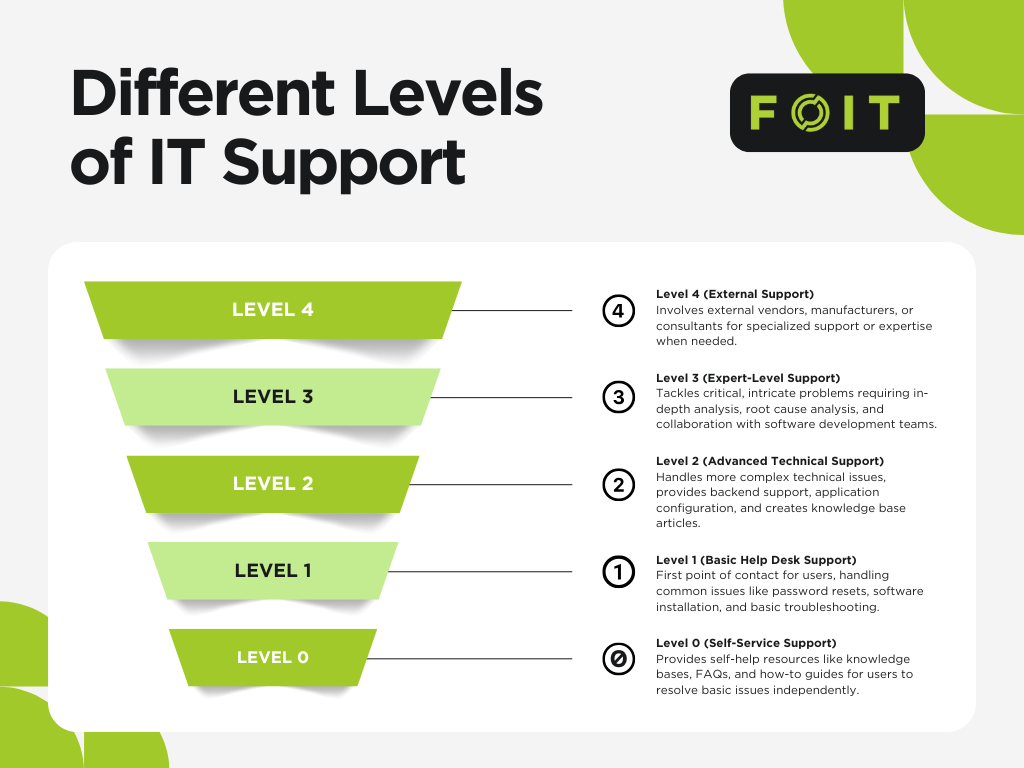
Level 0: Self-Service Support
Level 0 support, also known as self-service support, encompasses a range of resources designed to assist users in finding solutions to their queries or troubleshooting basic issues. This level acts as the first line of defence, allowing users to access information and guidance before escalating their requests to higher support tiers.
Examples of Level 0 Support Resources:
- Frequently Asked Questions (FAQs): Comprehensive lists of common questions and their corresponding answers, covering a wide range of topics related to the company’s products, services, or technologies.
- Knowledge Bases: Searchable repositories of articles, tutorials, and documentation that provide step-by-step instructions for resolving common issues or performing specific tasks.
- Chatbots: AI-powered virtual assistants that can understand natural language queries and provide relevant information or guidance based on their programmed knowledge base.
- How-to Guides: Detailed instructional materials, such as videos, infographics, or downloadable manuals, that walk users through various processes or procedures.
Level 1: Basic Help Desk Support

Level 1 support personnel are responsible for addressing and resolving common, straightforward issues that do not require advanced technical expertise. They act as the primary interface between users and the IT support team, providing friendly and efficient assistance.
Responsibilities of Level 1 Support:
- Basic Troubleshooting: Assisting users with common problems such as software installation, printer issues, or basic hardware troubleshooting.
- Password Resets: Resetting passwords for user accounts and providing guidance on password policies and best practices.
- User Account Management: Creating, modifying, or deactivating user accounts as per organisational policies and procedures.
- Basic Software and Hardware Support: Addressing queries related to standard software applications and peripheral devices.
- Ticket Management: Logging and prioritising support requests, ensuring proper documentation and tracking.
Skills Required for Level 1 Support Personnel:
- Customer Service: Excellent communication skills, patience, and the ability to interact with users in a friendly and professional manner.
- Basic Technical Knowledge: A foundational understanding of common software applications, operating systems, and hardware components.
- Problem-Solving: Analytical thinking and the ability to follow established troubleshooting procedures to resolve basic issues.
- Documentation: Strong writing and documentation skills to accurately capture and convey information.
Escalation to Level 2 Support:
While Level 1 support personnel are equipped to handle common issues, they are not expected to resolve complex or advanced technical problems. In such cases, tickets are escalated to Level 2 support, where more experienced and technically skilled personnel can take over the troubleshooting process.
Level 2: Advanced Technical Support

What is Level 2 support?
Level 2 support, often referred to as advanced technical support, is staffed by highly skilled professionals with in-depth knowledge of the company’s systems, applications, and technologies. They possess the ability to diagnose and resolve intricate technical problems, ensuring efficient and effective resolution of escalated issues.
Responsibilities of Level 2 Support:
- In-depth Troubleshooting: Conducting advanced troubleshooting and analysis to identify and resolve complex technical problems related to hardware, software, networks, and other systems.
- Backend Support: Providing support for back-end systems, servers, databases, and other critical infrastructure components.
- Creating Knowledge Base Articles: Documenting solutions and best practices in the form of comprehensive knowledge base articles for future reference and training purposes.
- Application and System Configuration: Assisting with the configuration and optimisation of applications, software, and systems to ensure optimal performance and functionality.
- Escalation Management: Determining when issues require further escalation to Level 3 support or vendor/manufacturer assistance.
Skills Required for Level 2 Support Personnel:
- Strong Technical Skills: Extensive knowledge and expertise in various technologies, programming languages, operating systems, and network architectures.
- Knowledge of the Company’s Tech Stack: In-depth familiarity with the specific hardware, software, and systems employed by the organisation.
- Analytical and Problem-Solving Abilities: The ability to analyse complex technical issues, identify root causes, and develop effective solutions.
- Documentation and Communication Skills: Strong written and verbal communication skills to document solutions and effectively communicate with both users and other support personnel.
Escalation to Level 3 Support:
While Level 2 support personnel possess advanced technical skills, there may be instances where issues are particularly complex or require specialised expertise. In such cases, tickets are escalated to Level 3 support, which typically involves expert-level engineers, developers, or vendor support teams.
Level 3: Expert-Level Support
What is Level 3 support?
Level 3 support represents the highest level of technical expertise within an organisation’s IT support structure. This tier is responsible for resolving intricate and critical issues that require in-depth analysis, advanced problem-solving skills, and specialised knowledge.
Responsibilities of Level 3 Support:
- Complex Issue Resolution: Tackling intricate technical problems that have eluded resolution at lower support levels, requiring advanced troubleshooting techniques and creative problem-solving approaches.
- Root Cause Analysis: Conducting thorough investigations to identify the underlying causes of complex issues, enabling the implementation of permanent solutions and preventive measures.
- Participation in Software Creation: Collaborating with software development teams to provide technical expertise, recommend improvements, and contribute to the creation of new software solutions.
- Technical Guidance and Mentoring: Providing guidance and mentorship to lower-level support personnel, sharing expertise and best practices to enhance their skills and knowledge.
- Vendor Collaboration: Working closely with external vendors, manufacturers, and third-party support teams to resolve issues related to their products or services.
Skills Required for Level 3 Support Personnel:
- Expert-Level Technical Knowledge: Extensive and comprehensive understanding of a wide range of technologies, programming languages, architectures, and industry best practices.
- Programming and Engineering Expertise: Proficiency in coding, scripting, and software engineering principles to develop custom solutions and resolve complex technical challenges.
- Critical Thinking and Problem-Solving: Advanced analytical and problem-solving abilities to tackle intricate issues and develop innovative solutions.
Effective Communication: Strong communication skills to articulate complex technical concepts to both technical and non-technical audiences.
Collaboration with Level 2 Support:
While Level 3 support personnel possess exceptional expertise, they often work in close collaboration with Level 2 support teams. This collaboration ensures a seamless flow of information and knowledge sharing, enabling effective issue resolution and continuous improvement of support processes.
Level 2 support personnel may escalate complex issues to Level 3, providing detailed documentation and context to facilitate efficient resolution. Conversely, Level 3 experts may provide guidance, recommendations, and best practices to Level 2 teams, enhancing their skills and knowledge.
Level 4: External Support (Optional)
While Levels 0 through 3 represent the internal support structure within an organisation, there may be instances where external assistance is required. This is where Level 4 support comes into play, providing access to specialised expertise and resources from third-party vendors, manufacturers, or other external support providers.
What is Level 4 support?
Level 4 support, also known as external support, refers to the involvement of external parties with specialised knowledge or resources to resolve issues that cannot be addressed by the organisation’s internal support teams. This level is typically optional and is utilised on an as-needed basis.
When to Use External Support:
Organizations may seek external support in the following scenarios:
- Vendor-Specific Issues: When facing problems related to third-party software, hardware, or products, the vendor or manufacturer may be better equipped to provide specialised support and troubleshooting assistance.
- Expertise Gaps: In cases where the organisation lacks specific technical expertise or resources required to resolve a particular issue, external support can bridge this gap and provide the necessary knowledge and skills.
- Capacity Limitations: During periods of high support demand or when internal resources are stretched thin, external support can provide additional capacity and help alleviate the workload on internal teams.
- Complex Customisations or Integrations: If an organisation has heavily customised or integrated third-party solutions, external support from the respective vendors or experts may be necessary to ensure proper functionality and compatibility.
Examples of External Support Providers:
- Vendors and Manufacturers: Software vendors, hardware manufacturers, and other technology providers often offer dedicated support channels for their products and services.
- Managed Service Providers (MSPs):Third-party companies that specialise in providing outsourced IT support and services, offering expertise across various technologies and platforms.
- Consultants and Subject Matter Experts: Independent consultants or consulting firms with specialised knowledge and experience in specific technologies or domains.
- Online Support Communities: Many vendors and open-source projects maintain online forums, discussion boards, or user communities where users can seek guidance and support from experts and fellow users.
Setting Up a Tiered IT Support System in Your Organization

A crucial step in setting up a tiered IT support system is to clearly define the roles and responsibilities of each support level. This ensures that support personnel understand their specific duties and the boundaries of their expertise, enabling efficient issue resolution and appropriate escalation when necessary.
- Level 0 (Self-Service Support): Develop comprehensive self-service resources, such as knowledge bases, FAQs, and how-to guides, to empower users to find solutions independently.
- Level 1 (Basic Help Desk Support): Outline the responsibilities of Level 1 personnel, including basic troubleshooting, password resets, user account management, and ticket handling.
- Level 2 (Advanced Technical Support): Define the scope of Level 2 support, which may include in-depth troubleshooting, backend support, configuration management, and knowledge base article creation.
- Level 3 (Expert-Level Support): Clearly delineate the responsibilities of Level 3 experts, such as complex issue resolution, root cause analysis, software development collaboration, and mentoring lower-level support teams.
- Level 4 (External Support): Establish guidelines for when and how to engage external support providers, such as vendors, manufacturers, or specialised consultants.
Creating Escalation Procedures:
Having clear steps for escalating issues to higher support levels is important. This ensures that complex problems get to the right people quickly.
Define Escalation Criteria
Establish specific criteria for when issues should be escalated from one support level to the next, such as issue complexity, priority, or impact on business operations.
Implement Escalation Workflows
Develop standardised workflows for escalating issues, including documentation requirements, communication protocols, and handoff procedures between support levels.
Establish Escalation Timelines
Set reasonable timelines for escalating issues based on their priority and severity, ensuring that critical issues are addressed promptly.
Train Support Personnel
Provide comprehensive training to support personnel on escalation procedures, ensuring they understand when and how to escalate issues effectively.
Implementing Ticketing Systems:
Ticketing systems are crucial for managing and tracking support requests, ensuring efficient issue resolution, and providing valuable data for performance analysis and continuous improvement.
Select a Suitable Ticketing Solution
Evaluate and choose a ticketing system that aligns with the organisation’s requirements, such as scalability, integration capabilities, and reporting features.
Configure Ticket Workflows
Set up ticket workflows that align with the defined support levels and escalation procedures, ensuring that tickets are automatically routed to the appropriate support personnel.
Integrate with Knowledge Bases
Integrate the ticketing system with the organisation’s knowledge bases, enabling support personnel to quickly access relevant information and solutions.
Establish Ticket Prioritisation
Implement a ticket prioritisation system based on factors such as issue severity, impact, and customer priority, ensuring that critical issues are addressed promptly.
Track and Analyse Metrics
Leverage the reporting capabilities of the ticketing system to track key performance indicators (KPIs), such as ticket resolution times, escalation rates, and customer satisfaction, enabling continuous improvement of the support process.
Best Practices for Each IT Support Level
Documentation
Maintain accurate and up-to-date documentation across all support levels, including knowledge bases, FAQs, troubleshooting guides, and solutions for complex issues, ensuring consistency and facilitating knowledge transfer.
Training
Implement regular training programmes tailored to each support level, covering relevant skills, technologies, and best practices, to ensure support personnel are equipped with the necessary expertise.
Knowledge Sharing
Foster a culture of knowledge sharing through collaborative platforms, mentorship programmes, and knowledge-sharing sessions, enabling support teams to leverage collective expertise and learn from one another.
Continuous Improvement
Regularly review support metrics, solicit feedback, conduct process audits, and stay informed about industry trends to identify areas for improvement and proactively adapt the support system to evolving needs.
Frequently Asked Questions
What are the key differences between Level 1, Level 2, and Level 3 support?
Level 1 provides basic troubleshooting and user support, Level 2 handles more complex technical issues and backend support, while Level 3 comprises expert personnel who resolve critical, intricate problems and conduct root cause analysis.
How can I determine the right level of support for my issue?
Start with self-service resources (Level 0) for basic queries. If the issue persists, contact Level 1 support. If they cannot resolve it, the ticket will be escalated to higher levels based on complexity.
What skills are required for each level of support?
Level 1 requires customer service and basic technical skills; Level 2 needs strong technical expertise and problem-solving abilities, while Level 3 demands expert-level knowledge, programming prowess, and critical thinking.
How to choose the right IT support provider for your business?
Evaluate providers based on their expertise, service levels, response times, scalability, industry experience, and alignment with your specific IT requirements and business goals.
Are levels the same as tiers?
Yes, the terms “levels” and “tiers” are used interchangeably in the context of IT support structures, referring to the different layers of support based on issue complexity and required expertise.